Hiroshi Hasegawa (Astro), live photos and a brief interview
Monday, March 30, 2009

The lack of posting could be a kind reflection of how hectic its been over here although, the film has pressed on and in the recent lull of posting we've actually been active at shows (Optrum, Hair Stylistics was properly exceptional) in addition to writing (Eye Yamataka interview in Dazed & Confused, Feb09), research and of course, editing footage into the darker (...and then brighter) hours of the day. Two weeks ago, one of our familiar faces, Hiroshi Hasegawa aka Astro collaborated with Batur Sonmez aka Analog Suicide from Istanbul Turkey at Shinjuku Urga. It was part of Lunatic Scope Volume 12, a line up which featured Bastard Noise, Defektro and Government Alpha.
Even though our cameraman couldn't make it at the last minute, we still followed through on Hasegawa's invitation. Afterwards, I had a nice albeit brief chat which we continued over email and so I'll post some words I translated from Hasegawa with some images to go along. We'll cut part 2 of our interview with Hasegawa-san in the near future and be sure to post a clip on our Youtube and Vimeo channels. In the meantime....
My attention was initially drawn to what seemed the latest addition to Hasegawa's fold up table- a mysterious retro-looking box and what appeared to be gold-coated paper. Hasegawa's set was centered around two metallic (about A4 size) sheets; shiny and paper thin. On where their role: "well, those metallic sheets, I had attached contact microphones which worked to pick up the friction and vibrations when I shook or slid the sheets against each other." In addition to the pedal set up below his table, Hasegawa was in true analog-form running the smaller contact microphones through a high voltage, all-tube analog annihilator; essentially the 'box' on the table which all eyes seemed to gravitate towards at one moment or another (I have a weblink if anyone wants to know). "Since my performance is based around my [analog, ed] synthesizer and effector set up, I'm somewhat limited to what extent I can move my body so these sheets gave me some more freedom not only in terms of sound but also movement." 
We briefly went on to discuss collaborations and how the evening went with both Sonmez and Reiko A. While Astro was enthralled with the sheets (and the occasional reattaching of the contact mics), he commented, "of course, I think its important to not only hear, but also to be conscious of your collaborator's sounds- its very much like a regular sign that is read." Meanwhile, Reiko A's dance performance, punctuated with fixed stares, corpse-like poses on the floor as well as firmly locked ones via angular jukes, was familiar of the Butoh aesthetic in broader strokes. "Yeah, I've been playing together with Reiko for quite some time and so we I can really read her signalspretty well. From that gathered sense of communication, I've come to more fully realize the importance of her signs and movements. I can observe the movements Reiko makes, and while they are natural reactions, from my sounds, and she's expressing in a physical way, its like a language that gives me a more composite idea of what is happening during the performance."

All photos courtesy N. Yamamoto-Masson, 2009
Video: Hiroshi Hasegawa at Earthdom, October 16 2008
Monday, November 17, 2008
Hiroshi Hasegawa aka Astro (Live, Tokyo October 16, 2008) from JapaneseNoiseProject on Vimeo.
Hiroshi Hasegawa, performing under the name Astro, invited us down to Earthdom in Shin Okubo to catch one of his solo sets. With a simple table propping up his audio lab: an analog synthesizer set in half of a suitcase in addition to a small mixer and some effects pedals. Almost in a ritual-like fashion, Hasegawa started his performance by lighting incense cradled in a small dish. Hasegawa’s set was rather linear and structural with introductions of sounds, drones and pulsing waves that entered so appropriately, one could assume they were time, or planned. At slower tempos, improvisation can get a bit blurry however it was clearly in real time. Enthralled, enthused and focused throughout, when the incense burned out, the set ended.
We had a great, long talk after the set with Hasegawa about the origins and motivations for his music. Hasegawa continued by filling us in on what was going on around the time when he was growing up and experimenting with his first synthesizer (which he borrowed from Mikawa of The Incapacitants).
We’ll archive that for now, but we’ll show a little performance here.
Video: The Incapacitants at UFO Club, October 12 2008
Sunday, November 9, 2008

Sunday night at the quaint UFO Club in Koenji, West Tokyo. One of Tokyo’s smaller venues hallmarked by walls inked with psychedelic swirls, furniture faintly echoing mod and a deep red velvet (or velour) curtain which opens and closes performances. We were there to film The Incapacitants, a rather rarity these days in Tokyo or anywhere else for that matter. I've chosen to focus on the Incapacitants as one of the key figures in the Japanese noise and avante garde community not only because of their lengthy discography going back to the early 80s, but also because of what Toshiji Mikawa (member of Hijokaidan) and Fumio Kosakai (formerly of C.C.C.C.) work to achieve.
The Incapacitants are loud. The sonic spectrum which they command quickly vary from excerpts distorted polemics, electronic pulses and heavy drones with a rhythm all their own. The power of their performance forces grimaces of curiousity in the audience if not actual spasmic dancing- in them too. Questions like, “What constitutes music or What is noise? Is this noise? Does sound (or I as a listener) have a threshold?” can be plausibly raised. Thats not to say their highly dynamic performance isn’t ordered in such a way to bring such an organized stream of sonic chaos via their technical work. In fact, few moments of an Incapacitants performance see them wandering too far from their equipment.
Mikawa and Kosakai’s performances are something of a journey for the two- attempting to arrive at either some kind of sonic threshold or meditative “Zen.” Yes, it is perhaps an exhausted statement that extreme sounds, by virtue of their harshness, produce some kind of mental and spiritual vacuum for the performer (and listener) that can be often referred to as a kind of Zen. But I think there’s more to it. With The Incapacitants, notions of compositional structure, melody, harmony, rhythm and crescendo are paved over as if they were an obstacle along the way. But to where? Is it a place where those conventional notions of ‘music concrete’ evaporate? Even, Is this noise? Is this music? Is it an untangling of forces that bound them not only musically but personally and socially? For Kosakai and Mikawa, performance is more of a transgressive act- not just arriving somewhere but going past that. The two musicians, government employees in their 40s, seemingly deconstruct structural forces which dominate their lives. To what degree the duo is consciously, or arbitrarily, navigating in that hellish squall of sound, is one topic we touched on. Our post show interview with The Incapacitants had the two generously, and rather cheerfully, explaining their performance, thoughts on “noise music,” composition and attitudes towards loving and no-so-adoring audiences alike. With Part 1 complete, we move on to Part 2.
A bit more background about the group, the Incapacitants are one of the oldest and well-known vocal based performance acts in Japan forming in Osaka in 1981 (originally a solo project of Mikawa). While drawing attention, respect as well as admirers, their performances and tours in Japan (including the extremely rare ones abroad) have become miniscule. In 1999, they had their first performance abroad (the Music Unlimited Festival in Wels, Austria) and in 2007, they were invited to the No Fun Festival in New York, curated by Carlos Giffoni (Myspace).
Thanks to Flavio for taking photos. Video: Vicente Gutierrez. Editing: Olivier Farmarchi. For our next clip, we're now going through footage from our interview and performance encounter with Hiroshi Hasegawa- the man is deep.
Atsuhiro Ito Live at Earthdom, Shin Okubo, July 26th- Rehearsal
Monday, August 4, 2008

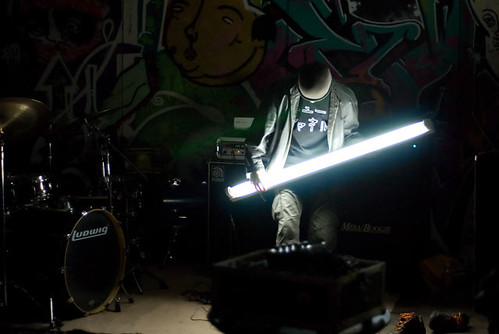
We actually ended up opting to shoot Ito during his rehearsal. It went great. As always, Ito was a candid fellow happy to share his work and welcomed us. We got some great footage and a crisp audio track- a big thanks goes to Sebastian Therre, here snapped in action by our Sebastian. We’ll be adding a voice over to our own edited version a bit later, but in the meantime, The Wire just posted a clip as a web exclusive which we edited for them to accompany our piece in issue #294. 
More to come: Yoshida Tatsuya of Ruins Alone (video interview, performance) and Hiroshi Hasegawa of C.C.C.C and Astro, who we are scheduled to film in the coming weeks.
Update - Atsuhiro Ito
Saturday, July 26, 2008
Hard to refrain from mentioning, but we're really looking forward to announcing more interviews and posting videos.
Keiji Haino + Jim O'Rourke + Yoshio Kuge.
May 25th, 2008 at Shinjuku JAM, Tokyo
Friday, July 25, 2008

The first show we decided to cover coincided shortly after the idea of this film's inception. With everything arranged the day of, we were excited to film this first time collaboration between one of Japan's foremost avante-garde guitarists, Haino, and music enthusiast Jim O'Rourke, who recently relocated to Tokyo. What's to be said for Yoshio Kuge is his lengthy and entrenched mainstay as one of Tokyo's finest hardcore drummers; currently active in percussion unit The Flying Rhythms (Here's a Youtube clip from 2007).
But actually, this wasn't the first time O'Rourke and Haino have come together on stage. The last time was October 2007 but since then, and up until the very afternoon of the show, the two had not rehearsed once. That's the word on the street- Haino never rehearses with a collaborator before a performance as a means of safeguarding the intricacies of improvisational dynamic.
To go back a step, the idea for Haino and O'Rourke's collaboration came at a quiet, 5-seater, quaint bar in Shinjuku's Golden Gai district which the two frequented. Since the place only has about 5 seats, we'll refrain from namedropping but we do plan to feature it in the film as one of Tokyo's somewhat key locales where members of the noise community meet. Another thing- the owner of the bar has been quite the matchmaker on the scene double timing as a promoter for shows at Shinjuku Jam and other venues within a stone's throw.
As soon as we get out of the editing room, we'll be posting clips from this ear-inflaming performance as well as a clip from our exclusive post-performance video interview with Haino-san.
My review of this performance is in the current issue of The Wire (#294). Photo by Sebastian Mayer.
That is all for now.

 Posts
Posts

